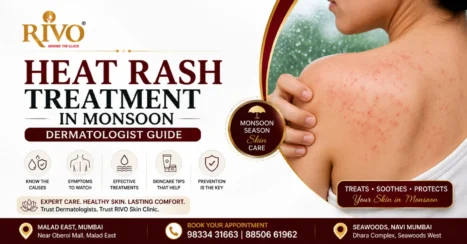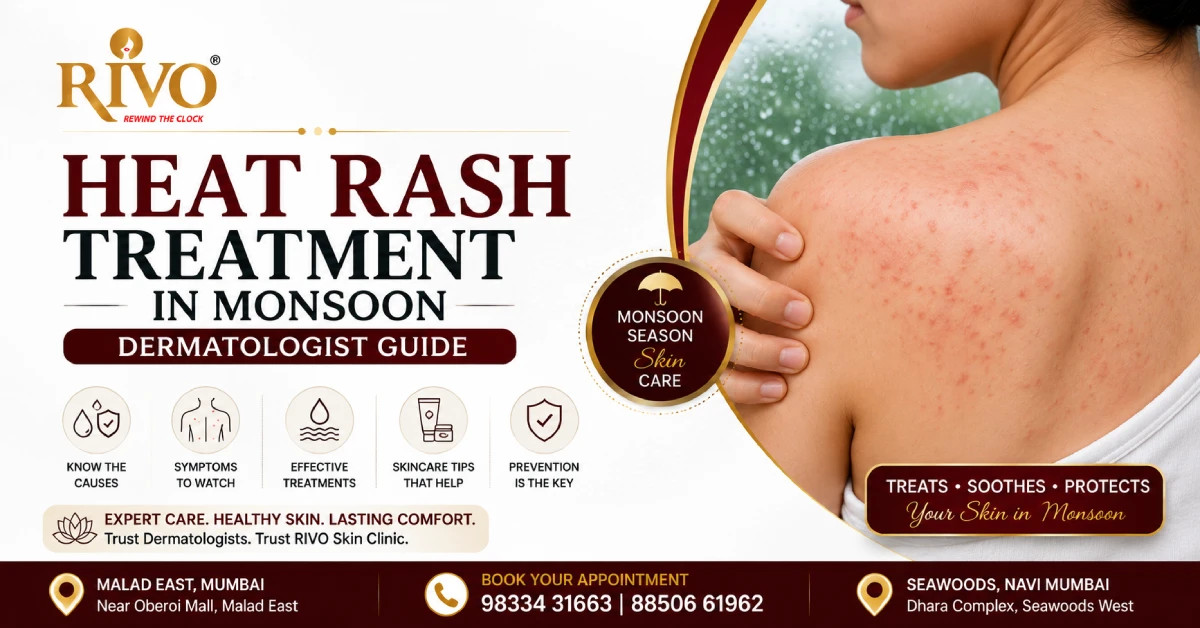
Mumbai’s monsoon does not just bring rain. For millions of people across the city, it brings something far more uncomfortable — that prickly, burning sensation on the skin that shows up uninvited every July and refuses to leave until the humidity drops. Heat rash treatment monsoon is one of the most searched skin topics during this season, and for good reason.
If you have been dealing with red, itchy bumps that seem to appear out of nowhere and get worse whenever you sweat, this guide is for you. We will cover what heat rash actually is, why monsoon makes it so much worse, what actually works for treatment, and when it is time to see a dermatologist.
What Is Heat Rash and Why Does Monsoon Trigger It?
Heat rash — medically called miliaria — occurs when sweat ducts become blocked and sweat cannot reach the skin surface. Instead of evaporating, the sweat becomes trapped beneath the skin, causing inflammation and that characteristic prickling or burning sensation.
During Mumbai’s monsoon, the humidity sits above 85% for weeks at a time. Sweat production goes up — but evaporation goes down. The result is that sweat sits on the skin constantly, significantly increasing the chance of duct blockage. This is why heat rash treatment monsoon consultations spike every July at skin clinics across the city.
Three things make monsoon particularly bad for heat rash:
High humidity — Sweat cannot evaporate, so ducts stay blocked longer and rash develops faster.
Tight or synthetic clothing — Clothes that do not breathe trap heat and moisture against the skin, accelerating duct blockage.
Friction — Areas where skin rubs against clothing or other skin — inner thighs, underarms, under the breasts — are the most vulnerable in humid conditions.
Types of Heat Rash — Not All Are the Same
Understanding the type matters because heat rash treatment monsoon varies depending on severity:
Miliaria crystallina — The mildest form. Tiny, clear fluid-filled bumps on the skin surface. Not itchy. Resolves on its own within days when skin cools.
Miliaria rubra — The most common type. Red, inflamed bumps that itch and prickle intensely. This is what most people mean when they say heat rash. Requires proper heat rash treatment monsoon to resolve.
Miliaria profunda — Deeper, flesh-coloured bumps. Less common but more persistent. Requires dermatologist assessment.
Miliaria pustulosa — Inflamed and infected version. Bumps become pustular. This is when self-treatment is not enough and medical intervention is needed.
At-Home Heat Rash Treatment in Monsoon — What Actually Works
For mild to moderate heat rash, the right at-home approach makes a significant difference:
Keep the skin cool and dry. This sounds obvious but it is the most effective step. Move to an air-conditioned environment when possible. Change out of wet or sweaty clothes immediately. Pat the affected area dry rather than rubbing.
Calamine lotion. One of the most reliable over-the-counter options for heat rash treatment monsoon. It soothes inflammation, reduces itching, and helps dry out the affected area. Apply a thin layer to the rash and allow it to dry.
Hydrocortisone cream (1%). For more inflamed or itchy rashes, a low-strength hydrocortisone cream can reduce inflammation. Use sparingly and only for short periods — not more than 7 days without medical advice.
Avoid heavy creams and oils. This is where many people make things worse. Applying coconut oil, heavy moisturisers, or any occlusive product on heat rash traps more heat and moisture, prolonging the rash.
Wear loose, breathable clothing. Cotton and moisture-wicking fabrics allow air circulation. This is the most practical preventive step for heat rash treatment monsoon throughout the season.
Cool water baths. Not cold — cool. Helps lower skin temperature and temporarily relieve discomfort. Avoid harsh soaps on the rash area.
📖 Also Read: Summer Skin Rash Treatment — Dermatologist Guide
When At-Home Treatment Is Not Enough
Most mild heat rashes resolve with the above measures within 3-4 days once the skin is kept cool and dry. But see a dermatologist when:
- The rash is spreading or worsening despite 3-4 days of home care
- Pustules or pus-filled bumps are forming — this indicates secondary bacterial infection
- The rash is on the face, near the eyes, or covering a large body surface area
- You have fever alongside the rash
- The rash is extremely painful rather than just itchy
At Rivo Skin Clinic, heat rash treatment monsoon cases that have progressed to infection or that keep recurring every monsoon season are assessed properly before treatment is prescribed. Self-treating infected heat rash with the wrong products often delays recovery.
Clinical Treatment for Persistent or Infected Heat Rash
When heat rash becomes infected or does not respond to home care, clinical treatment is required:
Prescription topical antibiotics — For infected heat rash with pustules, prescription-strength antibiotic creams target the bacterial infection without affecting the surrounding skin.
Oral antibiotics — For widespread or deeply infected heat rash, a short course of oral antibiotics may be prescribed.
Prescription-strength antihistamines — For severe itching that disrupts sleep or daily function, prescription antihistamines provide stronger relief than OTC options.
Medical facials — For patients who get recurring heat rash every monsoon, a targeted medical facial that deep-cleans the skin and unblocks congested areas can significantly reduce frequency and severity.
💬 Heat rash not clearing up after a week? Come in for a proper assessment.
📞 +91 9833431663 | +91 8850661962
Prevention — Making Monsoon More Bearable for Heat Rash-Prone Skin
The best heat rash treatment monsoon approach is preventing it from becoming severe in the first place:
Shower after sweating — Do not let sweat sit on the skin. Post-commute and post-exercise showers make a significant difference.
Use a light, non-comedogenic moisturiser — Hydration is still important but choose gel-based, oil-free options that do not block sweat ducts.
Antifungal powder in high-risk areas — A light dusting under the breasts, in the groin, and between thighs reduces friction and moisture buildup in areas most prone to heat rash.
Stay hydrated — Internal hydration helps regulate body temperature and reduces overall sweat production.
Avoid outdoor activity during peak heat hours — Between 11 AM and 4 PM even during monsoon, heat and humidity peak. Reducing outdoor exposure during these hours significantly reduces heat rash risk.
🔗 Also Read: Acne Prone Skin in Monsoon — Dermatologist Guide
Rivo's Clinical Perspective
Rashmy Naik, Aesthetic, Diet & Nutrition Consultant at Rivo Skin Clinic, addresses dietary factors that most patients overlook:
“Heat rash is a skin response to heat and humidity — but internal factors matter too. Patients who are well-hydrated and have a diet low in processed foods tend to recover faster. Excess sugar and refined carbohydrates increase inflammation, which can make heat rash more persistent and uncomfortable.”
Frequently Asked Questions (FAQs)
Mild heat rash typically resolves in 3-4 days once the skin is kept cool and dry. More severe or infected heat rash can persist for 1-2 weeks and may require heat rash treatment monsoon with prescription medication.
No — heat rash is not contagious. It is caused by blocked sweat ducts, not by an infectious organism. You cannot spread it to others or catch it from someone else.
Avoid direct ice on heat rash — the extreme cold can cause additional skin irritation. Use cool water or a cool damp cloth instead to reduce temperature and discomfort.
Keep the skin cool and dry, apply calamine lotion, wear loose cotton clothing, and avoid heavy creams or oils on the affected area. This combination resolves most mild heat rash treatment monsoon cases within 3-4 days.
Avoid heavy or oil-based moisturisers on active heat rash — they trap moisture and heat. A very light, gel-based, oil-free moisturiser can be used on surrounding skin if needed.
See a dermatologist if the rash has not improved after 4-5 days of home care, if pustules are forming, if you have fever, or if the rash is covering a large area or located on the face.
Contact Us - Rivo Skin Care Clinic
Dealing with persistent heat rash this monsoon? Our team will assess your skin, determine the type and severity, and recommend the right heat rash treatment monsoon plan — whether that is home care guidance or clinical treatment.
📞 +91 9833431663 📞 +91 8850661962
📍 Mumbai: Malad East, Near Oberoi Mall (Goregaon East)
📍 Navi Mumbai: Seawoods, Sector 44A
🌐 Book a Consultation | See Our Results | Explore All Treatments