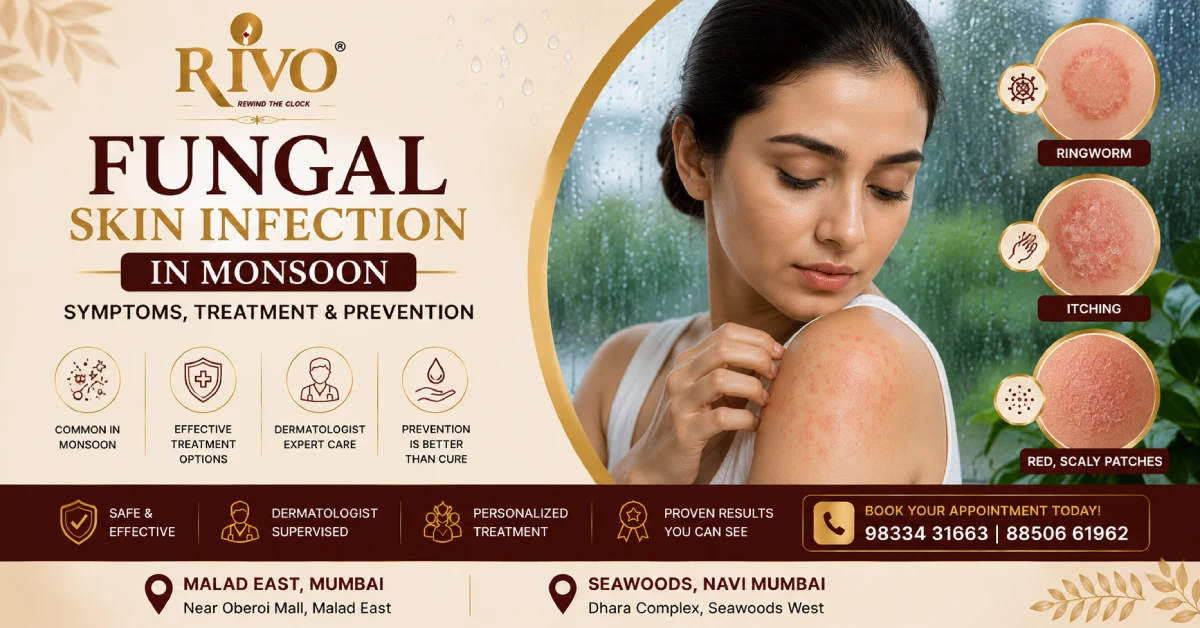
Mumbai’s monsoon brings more than just rain. Persistent humidity above 85%, constant sweating, and wet clothing create exactly the conditions that fungi need to thrive. For dermatologists at Rivo Skin Clinic, fungal skin infection treatment monsoon consultations spike every July — and patients who come in earliest recover fastest.
This guide covers causes, identification, treatment, and prevention.
Why Monsoon Creates the Perfect Environment for Fungal Infections
Fungi responsible for common skin infections — primarily dermatophytes and Candida species — are always present in the environment. What changes in monsoon is the environment on and around the skin.
Fungi need three things to establish an infection: warmth, moisture, and a surface. During Mumbai’s monsoon, all three are in constant supply. Sweat cannot evaporate in high humidity, so it sits on the skin surface for extended periods. Wet clothing remains in contact with skin. Areas where skin folds — groin, underarms, beneath the breasts, between toes — stay perpetually damp. This is why fungal skin infection treatment monsoon is needed more urgently during July and August than any other time of year.
An important detail many people miss: fungi do not only grow on dirty skin. Personal hygiene matters, but even clean skin that stays consistently moist in humid conditions is vulnerable. This is not a hygiene problem — it is a climate problem.
Common Fungal Infections in Monsoon — How to Identify Them
Correct identification matters because different fungal infections require different treatment approaches. Fungal skin infection treatment monsoon that is wrong for the specific type will not work — and may make the infection worse.
➡️ Tinea Cruris (Ringworm of the Groin / Jock Itch)
The most common monsoon fungal infection. Appears as a red, ring-shaped rash in the groin, inner thighs, or buttocks. The border is typically raised and scaly, with a clearer centre. Intensely itchy, especially after sweating. More common in men but affects women too.
➡️ Tinea Pedis (Athlete's Foot)
Affects the spaces between toes and the soles of the feet. Causes peeling, cracking, itching, and sometimes blistering. Particularly common in monsoon when feet stay damp in wet footwear throughout the day.
➡️ Tinea Versicolor (Pityrosporum Folliculitis)
A yeast-based infection caused by Malassezia. Appears as small discoloured patches — lighter or darker than surrounding skin — most commonly on the back, chest, and shoulders. The patches may be subtly scaly and can merge into larger areas. Often mistaken for pigmentation.
➡️ Candidal Intertrigo
A Candida infection that occurs in skin folds — under the breasts, in the groin, or under the belly. Appears as a bright red, moist rash with satellite pustules at the edges. Painful and raw rather than just itchy.
| Infection Type | Location | Key Identifying Feature |
| Tinea Cruris | Groin, inner thighs | Ring-shaped, raised border |
| Tinea Pedis | Between toes, soles | Peeling, cracking, blistering |
| Tinea Versicolor | Back, chest, shoulders | Discoloured patches, scaly |
| Candidal Intertrigo | Skin folds | Bright red, moist, satellite spots |
Fungal Skin Infection Treatment in Monsoon — What Actually Works
Fungal skin infection treatment monsoon depends on the type, location, and severity of the infection. This is why self-diagnosis and over-the-counter treatment sometimes fail — the wrong antifungal applied to the wrong infection produces no results.
➡️ Topical Antifungals — First Line Treatment
For mild to moderate infections, dermatologist-prescribed topical antifungals are the standard first step. Clotrimazole, miconazole, ketoconazole, and terbinafine creams target different fungal species. The right choice depends on which fungus is responsible.
A common mistake with fungal skin infection treatment monsoon is stopping the cream too early. The infection may look better within a week, but fungi deep in the skin layers are still active. Stopping early leads to recurrence — often worse than the original infection. A full course of 2-4 weeks is typically required.
➡️ Oral Antifungals — For Moderate to Severe Cases
When the infection is widespread, deeply established, or recurring, topical treatment alone is insufficient. Oral antifungals — fluconazole, itraconazole, or terbinafine — are prescribed based on the specific fungal species identified. These reach the infection systemically, which topical creams cannot do for deeper infections.
➡️ What Not to Use
A significant problem in monsoon fungal infections is the misuse of steroid-based creams. Many combination creams available over the counter contain both an antifungal and a steroid. While the steroid reduces visible redness and itching quickly, it also suppresses the immune response that the skin needs to fight the fungus. The result is tinea incognito — an infection that looks improved on the surface but is spreading underneath. This makes subsequent fungal skin infection treatment monsoon significantly harder.
💬 Rash that is spreading despite home treatment? A proper diagnosis changes everything. 📞 +91 9833431663 | +91 8850661962
When to See a Dermatologist
Many people attempt home treatment first — and this is reasonable for mild cases. But see a dermatologist when:
- The rash is spreading despite 1-2 weeks of antifungal cream
- The infection is in a sensitive area — face, genitals, or extensive body surface
- You have diabetes, a compromised immune system, or are on immunosuppressants — fungal infections in these patients need specialist management
- The rash is painful rather than just itchy — this may indicate a secondary bacterial infection
- You have recurring infections every monsoon season
At Rivo Skin Clinic, fungal skin infection treatment monsoon begins with accurate diagnosis — clinical examination and, where needed, a skin scraping test — before any treatment is prescribed. This step is what separates effective treatment from guesswork.
📖 Also Read: Skin Infections Caused by Bacteria — Types, Causes & Treatment
Prevention — The Habits That Actually Matter
For fungal skin infection treatment monsoon to hold, and for those who have not yet developed an infection to stay clear, prevention habits during the season are essential:
Keep skin dry — change wet clothing quickly and pat skin folds dry after bathing.
Use antifungal powder in the groin, underarms, and between toes after bathing.
Wear breathable fabrics — cotton allows air circulation; synthetic fabrics trap moisture.
Do not share towels or footwear — fungal infections are contagious through shared items.
Dry footwear properly — wet shoes create a fungal environment overnight.
Shower after sweating — this removes the sweat layer that fungi feed on.
🔗 Also Read: Rainy Season Skin Care Routine — Dermatologist Guide
Rivo's Approach — Diagnosis Before Treatment
Rashmy Naik, Aesthetic, Diet & Nutrition Consultant at Rivo Skin Clinic, makes this point consistently to patients:
“The biggest mistake I see with monsoon fungal infections is patients using the wrong cream for weeks before coming in. Some infections look identical on the surface but need completely different treatment. Getting the diagnosis right first is not a formality — it is what makes the treatment work.”
At Rivo, fungal skin infection treatment monsoon protocols are never based on appearance alone. Every fungal skin infection treatment monsoon case begins with proper diagnosis. Culture testing and clinical assessment guide every treatment plan.
🔗 Also Read: Acne Prone Skin in Monsoon — Dermatologist Guide
Frequently Asked Questions (FAQs)
Fungal infections typically have a ring-shaped border, are intensely itchy (especially when warm), and worsen in skin folds or damp areas. However, many rashes look similar — eczema, psoriasis, and bacterial infections can all mimic fungal infections. When in doubt, a dermatologist assessment is always more reliable than self-diagnosis.
Yes — scratching and touching other skin spreads the infection. Tinea can spread from feet to groin. Keep the area clean and avoid scratching.
Mild infections typically respond in 2-4 weeks of consistent antifungal cream use. More established or widespread infections may require 4-6 weeks of topical treatment or a course of oral antifungals. Stopping treatment early is the most common reason for recurrence.
No — steroid creams suppress the immune response that fights the fungus, causing the infection to appear better while spreading underneath. This is one of the most common causes of treatment-resistant fungal infections.
Recurring infections usually mean incomplete previous treatment, an underlying condition like diabetes, or persistent environmental exposure. A dermatologist can identify the cause and recommend a prevention protocol.
Yes — with the correct treatment and completing the full course. Prevention habits during monsoon reduce recurrence significantly.
Contact Us - Rivo Skin Care Clinic
Persistent or spreading rash this monsoon? Our team will diagnose the exact type of infection and prescribe the right treatment — so you are not spending weeks on something that is not working.
📞 +91 9833431663 📞 +91 8850661962
📍 Mumbai: Malad East, Near Oberoi Mall (Goregaon East)
📍 Navi Mumbai: Seawoods, Sector 44A
🌐 Book a Consultation | See Our Results | Explore All Treatments