Face serums have become one of the most talked-about skincare products in the last few years. Walk into any pharmacy or scroll through any beauty page and you will find dozens of serums promising brighter skin, fewer wrinkles, smaller pores, and more. Most of the conversation is about their benefits.
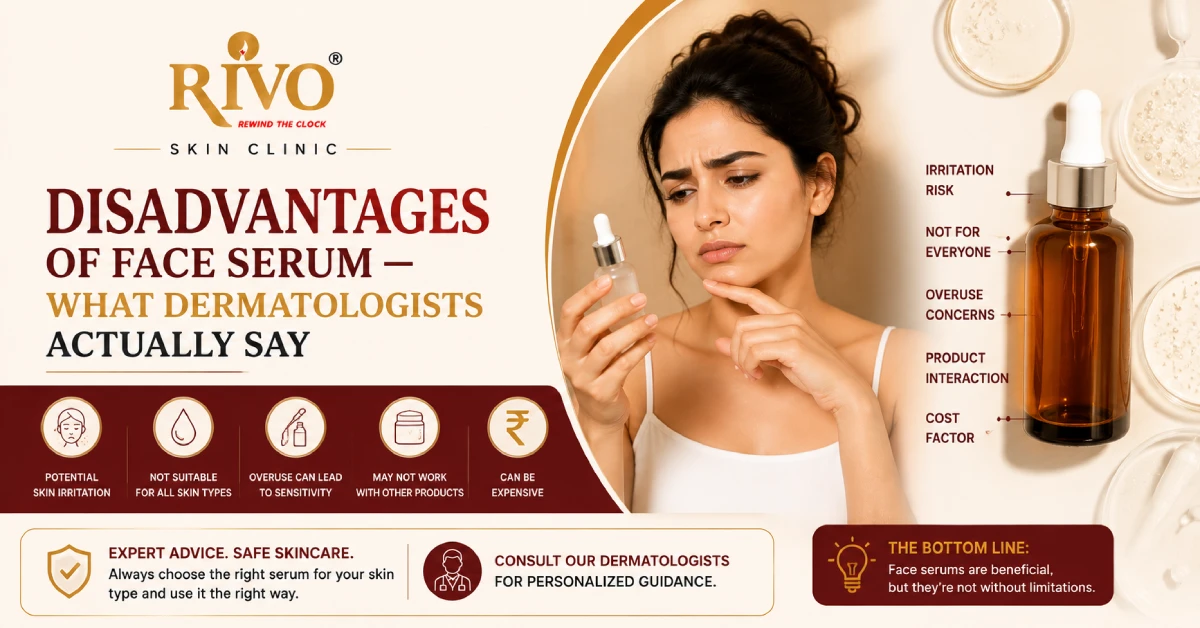
But here is what does not get discussed enough — the disadvantages of face serum that dermatologists see regularly in their clinics. Patients come in with irritated skin, unexpected breakouts, and worsened conditions, often traced back to using the wrong serum, using it incorrectly, or layering too many actives at once.
This is not an argument against serums. Many of them are genuinely effective. But understanding the disadvantages of face serum helps you use them smarter — and avoid the mistakes that dermatologists see most often.
What Is a Face Serum and Why Is It Different?
Before getting into the disadvantages of face serum, it helps to understand what makes serums different from other skincare products.
Serums are lightweight, fast-absorbing formulations with a high concentration of active ingredients — niacinamide, vitamin C, retinol, hyaluronic acid, AHAs, and others. They are designed to deliver these actives deeper into the skin than a regular moisturiser can.
That concentration is both their strength and the source of most disadvantages of face serum — high-strength actives, especially when used incorrectly or combined carelessly, can cause real skin problems.
The Main Disadvantages of Face Serum
➡️ 1. Irritation and Sensitivity
This is the most common complaint dermatologists hear about serums. High concentrations of active ingredients — particularly vitamin C, retinol, AHAs like glycolic acid, and exfoliating acids — can cause redness, stinging, peeling, and prolonged sensitivity, especially on skin that is not accustomed to them.
Introducing a strong serum too quickly, or using it more frequently than recommended, triggers a skin barrier disruption. The skin becomes reactive, uncomfortable, and paradoxically more prone to the concerns the serum was meant to address.
The disadvantages of face serum related to irritation are most common when people:
- Use a high concentration without building up gradually
- Apply a serum on compromised or already sensitised skin
- Use multiple active serums at the same time
📖 Also Read: Are Face Serums Harmful for Our Skin? — Rivo Skin Clinic
➡️ 2. Breakouts and Purging — And the Confusion Between Them
One of the most misunderstood disadvantages of face serum is that some serums cause breakouts. This happens in two ways:
Purging — Some actives, particularly retinol and AHAs, accelerate cell turnover. This pushes existing congestion to the surface faster than it would naturally appear, causing a temporary wave of pimples in the first 4-6 weeks. This is expected and usually resolves.
Actual breakouts — Some serum formulations contain occlusive ingredients, silicones, or oils that clog pores — particularly on acne-prone or oily skin. These cause new breakouts that will not resolve on their own.
Knowing the difference matters because the response is opposite — purging requires patience, actual breakouts require stopping the product.
➡️ 3. Using the Wrong Serum for Your Skin Type
This is one of the most significant disadvantages of face serum in practice — and one of the most avoidable. Serums are not one-size-fits-all. A vitamin C serum formulated for dry skin may be too occlusive for oily skin. A retinol serum appropriate for normal skin may be too strong for sensitive skin.
| Skin Type | Common Mistake | Better Approach |
| Oily / Acne-prone | Using oil-based or silicone-heavy serums | Gel-based, non-comedogenic formulas |
| Dry / Sensitive | Using high-strength AHAs or vitamin C | Start with lower concentrations |
| Combination | Using one serum for the whole face | Target different zones differently |
| Darker Indian skin | Using high-concentration vitamin C without sun protection | Always pair with SPF 50 |
➡️ 4. Layering Too Many Actives at Once
Modern skincare culture encourages using multiple serums — vitamin C in the morning, retinol at night, niacinamide after toner, an AHA on alternate evenings. For most people, this is too much.
The disadvantages of face serum when stacking multiple actives include:
- Ingredient conflicts — Some combinations reduce each other’s effectiveness or cause instability. Vitamin C and certain forms of niacinamide were historically thought to conflict. Retinol and AHAs used together can cause significant irritation.
- Barrier overload — Too many actives collectively strip the skin barrier, leading to dehydration, redness, and sensitivity.
- Inability to identify problems — When you use five products at once, it is impossible to know which one caused a reaction.
➡️ 5. Cost vs Actual Benefit
One of the less-discussed disadvantages of face serum is the significant investment many serums require — often without proportionate results.
Many premium serums are priced based on marketing rather than ingredient concentrations that will produce clinical results. A niacinamide serum at 2% does significantly less than one at 10%, but both may be priced similarly. Without knowing what concentration actually produces results, it is easy to spend a great deal on products that deliver minimal improvement.
This does not mean all expensive serums are ineffective — some are genuinely worth the investment. But the disadvantages of face serum in this category are real: many people cycle through expensive products without achieving what clinical treatments can deliver more directly.
➡️ 6. Sun Sensitivity After Use
Several of the most popular serum ingredients significantly increase the skin’s sensitivity to UV radiation:
- Retinol — Makes skin photosensitive. Must be used at night only, with SPF every morning.
- AHAs (glycolic acid, lactic acid) — Exfoliate the skin surface, increasing UV sensitivity for several days after use.
- Vitamin C — While it is an antioxidant that helps neutralise UV damage, it does not replace sunscreen and the skin is more reactive without proper SPF protection.
This is one of the most practically important disadvantages of face serum — because it means that the serum you are using for brightening or anti-ageing can actively worsen pigmentation if you are not wearing SPF 50 every morning without exception.
💬 Not sure which serum suits your skin? Book a consultation at Rivo Skin Clinic. 📞 +91 9833431663 | +91 8850661962
➡️ 7. Packaging and Stability Issues
Active ingredients in serums — particularly vitamin C and retinol — are notoriously unstable. Vitamin C oxidises when exposed to air and light, turning the serum orange or brown and making it ineffective or potentially irritating. Retinol degrades with light and heat exposure.
If your vitamin C serum has changed colour, it has likely oxidised. Using it is one of the less obvious disadvantages of face serum — it provides none of the intended benefit and may cause irritation.
Look for serums in dark, airtight packaging. Store them away from direct sunlight and heat. Do not keep them in a bathroom where temperature and humidity fluctuate constantly.
When Serums Are Not Enough — What Dermatologists Recommend Instead
For skin concerns that are not responding to topical serums — persistent acne, deep pigmentation, significant texture issues — clinical treatments go where serums cannot:
Chemical peels — Deliver active acids at controlled concentrations directly to the skin, producing results that topical serums cannot match for pigmentation and texture improvement.
HydraFacial — Infuses medical-grade serums directly into freshly extracted pores, bypassing the absorption limitations of topical application. HydraFacial at Rivo uses clinical-grade actives that are significantly more potent than anything available over the counter.
Microneedling — Creates channels in the skin that allow serums to penetrate significantly deeper than surface application. Used in combination with targeted serums, results are measurably better than topical use alone.
Laser toning — For pigmentation that serums have not adequately addressed, laser toning targets melanin deposits at a deeper level. Laser toning at Rivo produces results in 3-4 sessions that months of serum use cannot replicate.
🔗 Also Read: Side Effects of Vitamin C Serum — What You Should Know
How to Use Serums Correctly — Dermatologist Tips
If you want to use serums effectively while avoiding the disadvantages of face serum, here is what dermatologists recommend:
Tip | Why It Matters |
Introduce one new serum at a time | Isolates reactions so you know what caused them |
Start with lower concentrations | Reduces irritation risk while skin adapts |
Always use SPF 50 in the morning | Prevents UV damage from photosensitising actives |
Do not layer more than 2 active serums | Prevents barrier overload and ingredient conflicts |
Patch test on the inner arm first | Identifies sensitivity before full face application |
Store serums correctly | Prevents oxidation and degradation of actives |
What Our Dermatologist Observes
Rashmy Naik, Aesthetic, Diet & Nutrition Consultant at Rivo Skin Clinic, sees this regularly:
“The most common serum-related issue I see is patients using too many actives at once without building up gradually. The skin barrier gets overwhelmed — and then everything becomes a problem. The simplest advice is to pick one serum for one concern, use it consistently for 8-12 weeks, and assess the result before adding anything else.”
Frequently Asked Questions (FAQs)
The main disadvantages of face serum include skin irritation from high-strength actives, breakouts from comedogenic formulations, increased sun sensitivity, ingredient conflicts when layering multiple serums, and instability issues with certain ingredients like vitamin C and retinol.
In most cases, serum-related skin reactions are reversible once the product is discontinued and the skin barrier is repaired. However, using a serum incorrectly on already compromised skin or in combination with other irritants can prolong recovery. Always introduce new actives gradually.
No — serums are optional. A basic routine of cleanser, moisturiser, and SPF is sufficient for healthy skin maintenance. Serums add targeted benefits for specific concerns but are not a requirement.
Niacinamide at 10% is one of the safest and most effective ingredients for Indian skin — it addresses pigmentation, oil control, and barrier function without significant irritation risk. Always pair with SPF 50 regardless of which serum you use.
It depends on the serum. Hyaluronic acid and niacinamide serums are generally safe for daily use. Retinol, AHAs, and high-concentration vitamin C are better used 2-3 times per week initially, building up gradually based on skin tolerance.
See a dermatologist when your skin concern has not improved after 8-12 weeks of consistent serum use, when you have experienced a reaction, or when the concern is moderate to severe — acne, significant pigmentation, or scarring. Clinical treatments produce results that topical serums cannot achieve for these cases.
Contact Us - Rivo Skin Care Clinic
Using serums but not seeing results — or dealing with a reaction? Our team will assess your skin, identify what is working against you, and recommend a plan that actually addresses your concern — whether that is the right topical routine or a clinical treatment that goes further.
📞 +91 9833431663 📞 +91 8850661962
📍 Mumbai: Malad East, Near Oberoi Mall (Goregaon East)
📍 Navi Mumbai: Seawoods, Sector 44A
🌐 Book a Consultation | See Our Results | Explore All Treatments